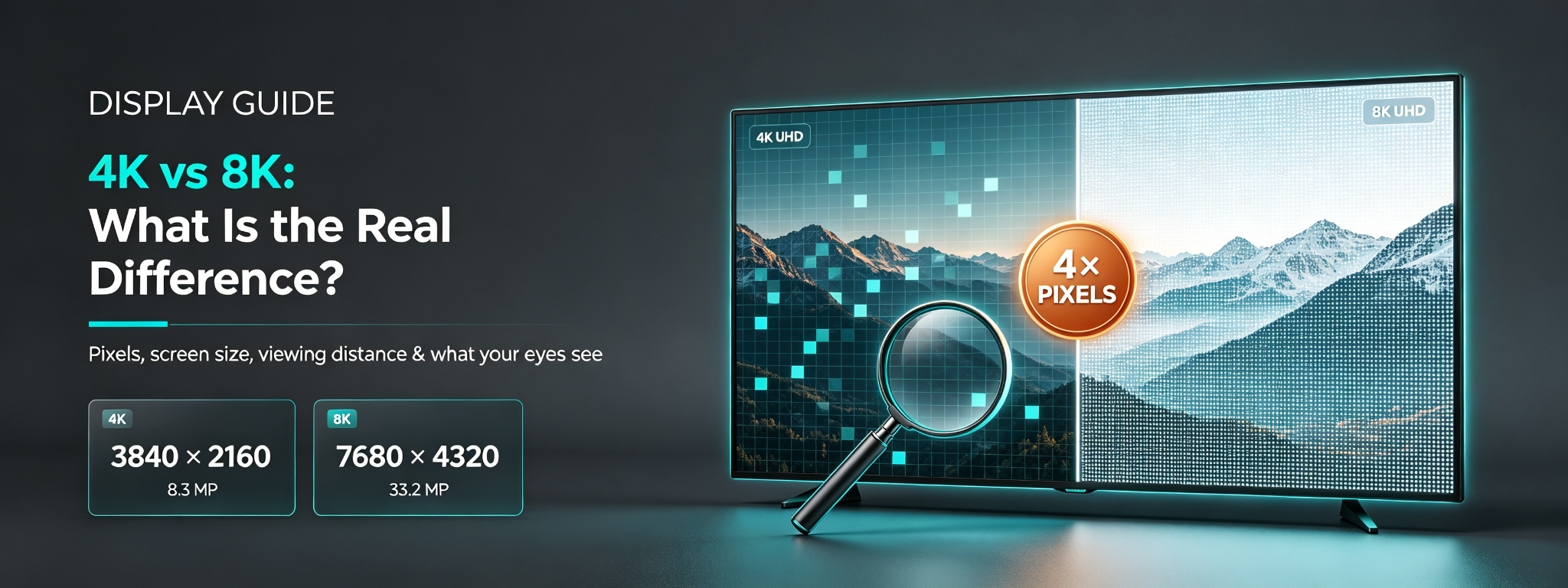
Every major display upgrade arrives with a flood of marketing terminology claiming a revolutionary jump in clarity. The transition from 1080p Full HD to 4K Ultra HD gave us four times the pixels, offering a undeniable, visually striking improvement on almost any standard living room screen. Now, 8K technology is widely available, promising four times the pixel count of 4K.
Does doubling the horizontal and vertical pixel density actually yield a visibly better picture, or have display manufacturers pushed past the limits of human visual perception?
The answer comes down to pixel density, screen scale, spatial visual acuity, and how content reaches the display.
Understanding the difference between 4K and 8K starts with basic grid mathematics. Resolution refers strictly to the pixel matrix grid that forms the image on a screen.
4K UHD (Ultra High Definition): Features a resolution of 3840 x 2160 pixels, totaling roughly 8.3 million pixels.
8K UHD: Features a resolution of 7680 x 4320 pixels, yielding roughly 33.2 million pixels.
While 8K quadruples the raw pixel density of 4K, pixel count alone does not dictate image quality. Contrast ratios, color volume, peak brightness, and dynamic range play equally critical roles in how your brain processes dynamic range on screen.
The fundamental factor determining whether 8K is worth consideration is human visual biology. The human eye processes clarity based on visual angle, measured in Arcminutes. Normal vision (20/20 vision) can resolve detail up to approximately 1 arcminute, or 60 Pixels Per Degree (PPD).
When a display hits a pixel density where your eye can no longer distinguish individual pixels at a given distance, adding more pixels yields diminishing returns. This threshold is known as the retina point.
| Screen Size | 4K Retina Distance (Pixels Blend) | 8K Optimum Distance (Noticeable Detail) |
| 55 Inches | 3.5 ft (1.0 m) | Under 1.8 ft (0.5 m) |
| 65 Inches | 4.1 ft (1.2 m) | Under 2.1 ft (0.6 m) |
| 75 Inches | 4.8 ft (1.4 m) | Under 2.4 ft (0.7 m) |
| 85 Inches | 5.4 ft (1.6 m) | Under 2.7 ft (0.8 m) |
| 100+ Inches | 6.4 ft (1.9 m) | Under 3.2 ft (1.0 m) |
At a standard couch distance of 8 to 10 feet from a 65-inch screen, the human eye physically cannot distinguish the difference between a native 4K signal and a native 8K signal. To perceive the finer textures rendered by an 8K display, you must either sit remarkably close or scale up to a screen size of 85 inches or larger.
Hardware capability consistently outpaces media delivery infrastructure.
4K has become the standard streaming and production target.
Streaming Platforms: Major services stream extensively in 4K HDR.
Physical Media: 4K Ultra HD Blu-ray discs deliver uncompressed audio alongside high-bitrate 4K video.
Gaming: Current-generation consoles and modern PC graphics hardware run games natively at 4K resolutions with high refresh rates.
Native 8K master files require massive storage bandwidth and encoding efficiency.
Native Broadcasts & Streaming: Very few platforms distribute native 8K content due to immense bandwidth requirements.
Production Costs: While cinema cameras shoot in 6K or 8K for cropping and stabilization flexibility in post-production, final master renders are usually finished in 4K (Digital Intermediate) before distribution.
Because native 8K content remains sparse, every 8K display relies heavily on real-time upscaling engines. When a 4K frame (3840x2160) is sent to an 8K panel (7680x4320), the television must generate 24.8 million missing pixels every frame.
Modern displays employ deep-learning neural network processors to handle this:
Nearest-Neighbor Interpolation (Legacy): Simply duplicates pixels, resulting in blurry edges and artifacts.
AI-Driven Pattern Recognition: Analyzes the edge boundaries, texture density, and contrast vectors in incoming 4K frames.
Real-Time Reconstruction: Re-creates higher frequency spatial detail using trained machine-learning models to fill in the missing pixel data seamlessly.
An advanced AI upscaler on a high-end 8K display can clean up compressed noise, improve edge definition, and make 4K video look noticeably sharper, even if it cannot recreate raw detail that was omitted from the source camera capture.
Pixel count is only one aspect of display design. High-tier 8K displays often serve as flagship hardware platforms for manufacturers, leading to tangential visual benefits:
Tighter Mini-LED Backlighting Control: Flagship 8K screens frequently sport more local dimming zones than mid-tier 4K counterparts, providing deeper black levels and higher contrast ratios.
Invisibly Fine Screen Grids: On massive panel sizes (85+ inches), 4K panels can display visible gaps between pixels (the "screen door effect") if you sit close. 8K density eliminates pixel gaps entirely.
Enhanced Spatial Depth Perception: When luminance control and high resolution align correctly, minute contrast details on object edges create a subtle sense of 3D-like visual depth without specialized glasses.
Your viewing distance is greater than 6 feet from a screen under 85 inches.
Your primary consumption consists of streaming media, console gaming, and physical 4K media.
You prioritize color reproduction, panel contrast, HDR brightness, and high refresh rates over raw pixel density.
You are setting up a dedicated theater space with an ultra-large display footprint (85 inches to 100+ inches).
You sit exceptionally close to your display surface for immersive simulation gaming or workstation editing setups.
You want flagship processing engines, premium panel construction, and complete future-proofing for ultra-high-density video pipelines.
Yes. All 8K displays feature onboard image processors that automatically upscale 1080p and 4K video feeds to fill the screen's full 7680x4320 resolution.
To send high-frame-rate native 8K signals (such as 8K at 60Hz or 4K at 120Hz uncompressed), you require an Ultra High Speed HDMI cable compliant with the HDMI 2.1 standard (capable of up to 48 Gbps bandwidth).
While top-tier modern graphics processors can output 8K signals, running modern graphics-intensive games at native 8K resolution requires substantial processing power. Most games rely on temporal upscaling techniques like DLSS or FSR to maintain stable frame rates at 8K output.


